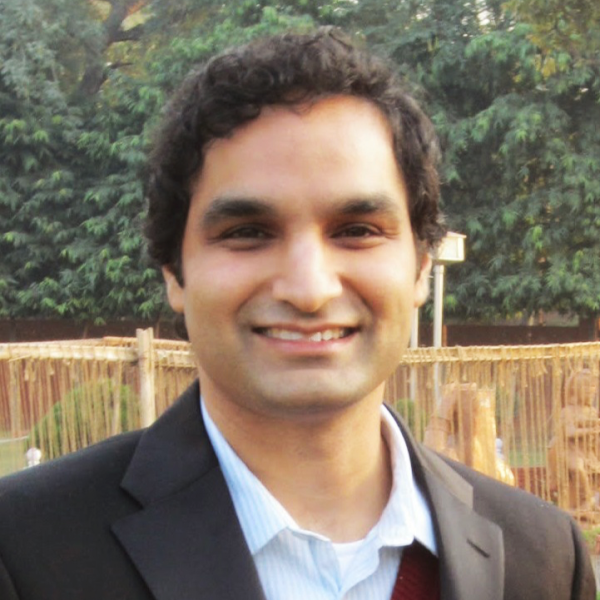
Arjun Singh
Arjun is an Engineering Fellow and Technical Lead for networking in Google. During his tenure in Google, he has worked on developing solutions for Google’s data center, Wide Area and Edge/Peering networks with a focus on Software-defined networking. Arjun has participated in over five generations of data center and wide area networking infrastructure at Google over 19 years and has been recognized with the ACM SIGCOMM Networking Systems Award and Test of Time Paper Award for his work. Before joining Google, Arjun received a PhD, M.S. in Electrical Engineering from Stanford University and a Bachelor of Technology in Computer Science and Engineering from the Indian Institute of Technology (IIT), Kharagpur.
Research Areas
Authored Publications
Sort By
CSIG: Congestion Signaling for Datacenter Transports
Abhiram Ravi
Brad Karp
MJ Akhbari
Weida Huang
Konstantinos Prasopoulos
2026
Preview abstract
Optimizing burst-heavy datacenter workloads necessitates fine-grained network control and visibility. We introduce CSIG, a protocol that delivers precise, multi-bit bottleneck congestion signals via a fixed-length Ethernet header. The architecture captures 𝜇s-granularity switch metrics, such as available bandwidth, and signals them to end-hosts using in-band, line-rate operations. We propose Fast Ramp-Up, a congestion control primitive that leverages these bottleneck signals to reduce median RPC latency by 20% and unclaimed bandwidth by 60% in production. Beyond transport-level performance, CSIG enables flow-aware observability by embedding 𝜇s-scale metrics into every packet, allowing individual application transfers to pinpoint their bottleneck location, such as the topology tier limiting their performance. CSIG thus transforms network telemetry from post-hoc correlation into a real time, contextaware capability. We demonstrate CSIG’s broad deployability by validating it across five generations of commodity switch hardware (up to 102.4 Tbps), four NIC generations, and five transport stacks. Our design proves that a streamlined Layer 2 approach, focusing exclusively on the principal path bottleneck, provides transport-agnostic gains without requiring forklift hardware upgrades.
View details
GGN: Experiences in Designing and Deploying Next-Generation Google Global Network
Richard Alimi
Arda Balkanay
Nachikethas Jagadeesan
Warren Martins
Arjun Muralidharan
Namrata Pralhad Kadam
Aman Shaikh
Sankalp Singh
Charith Wickramaarachchi
Min Zhu
2026
Preview abstract
Cloud and AI/ML workloads are posing unprecedented new requirements on the wide-area network: it must combine strict availability, massive growth, and feature agility. It became increasingly clear that traditional WAN designs were ill-equipped to adapt to these requirements.
We present Google's Global Network (GGN), a major architectural redesign of our WAN that evolves B2 and B4 into a single, modular, and highly available software-defined network. The architecture is designed around three pillars: (1) A modular design of functional domains with well-defined APIs; (2) a physically sharded and regionalized core for fault isolation and horizontal scaling; (3) a vendor-agnostic hardware strategy based on open standards. We share the multi-year deployment journey of GGN, including a safe, host-steered migration strategy, and demonstrate its ability to improve network availability and reaction time to failures, setting a foundation for a planet-scale modern WAN.
View details
CAPA: An Architecture For Operating Cluster Networks With High Availability
Bingzhe Liu
Mukarram Tariq
Omid Alipourfard
Rich Alimi
Deepak Arulkannan
Virginia Beauregard
Patrick Conner
Brighten Godfrey
Xander Lin
Mayur Patel
Joon Ong
Amr Sabaa
Alex Smirnov
Manish Verma
Prerepa Viswanadham
Google, Google, 1600 Amphitheatre Pkwy, Mountain View, CA 94043 (2023)
Preview abstract
Management operations are a major source of outages for networks. A number of best practices designed to reduce and mitigate such outages are well known, but their enforcement has been challenging, leaving the network vulnerable to inadvertent mistakes and gaps which repeatedly result in outages. We present our experiences with CAPA, Google’s “containment and prevention architecture” for regulating management operations on our cluster networking fleet. Our goal with CAPA is to limit the systems where strict adherence to best practices is required, so that availability of the network is not dependent on the good intentions of every engineer and operator. We enumerate the features of CAPA which we have found to be necessary to effectively enforce best practices within a thin “regulation“ layer. We evaluate CAPA based on case studies of outages prevented, counterfactual analysis of past incidents, and known limitations. Management-plane-related outages have substantially reduced both in frequency and severity, with a 82% reduction in cumulative duration of incidents normalized to fleet size over five years
View details
Aquila: A unified, low-latency fabric for datacenter networks
Hema Hariharan
Eric Lance
Moray Mclaren
Stephen Wang
Zhehua Wu
Sunghwan Yoo
Raghuraman Balasubramanian
Prashant Chandra
Michael Cutforth
Peter James Cuy
David Decotigny
Rakesh Gautam
Rick Roy
Zuowei Shen
Ming Tan
Ye Tang
Monica C Wong-Chan
Joe Zbiciak
Aquila: A unified, low-latency fabric for datacenter networks (2022)
Preview abstract
Datacenter workloads have evolved from the data intensive, loosely-coupled workloads of the past decade to more tightly coupled ones, wherein ultra-low latency communication is essential for resource disaggregation over the network and to enable emerging programming models.
We introduce Aquila, an experimental datacenter network fabric built with ultra-low latency support as a first-class design goal, while also supporting traditional datacenter traffic. Aquila uses a new Layer 2 cell-based protocol, GNet, an integrated switch, and a custom ASIC with low-latency Remote Memory Access (RMA) capabilities co-designed with GNet. We demonstrate that Aquila is able to achieve under 40 μs tail fabric Round Trip Time (RTT) for IP traffic and sub-10 μs RMA execution time across hundreds of host machines, even in the presence of background throughput-oriented IP traffic. This translates to more than 5x reduction in tail latency for a production quality key-value store running on a prototype Aquila network.
View details
Orion: Google’s Software-Defined Networking Control Plane
Amr Sabaa
Henrik Muehe
Joon Suan Ong
Karthik Swaminathan Nagaraj
KondapaNaidu Bollineni
Lorenzo Vicisano
Mike Conley
Min Zhu
Rich Alimi
Shawn Chen
Shidong Zhang
Waqar Mohsin
(2021)
Preview abstract
We present Orion, a distributed Software-Defined Networking platform deployed globally in Google’s datacenter (Jupiter) as well as Wide Area (B4) networks. Orion was designed around a modular, micro-service architecture with a central publish-subscribe database to enable a distributed, yet tightly-coupled, software-defined network control system. Orion enables intent-based management and control, is highly scalable and amenable to global control hierarchies.
Over the years, Orion has matured with continuously improving performance in convergence (up to 40x faster), throughput (handling up to 1.16 million network updates per second), system scalability (supporting 16x larger networks), and data plane availability (50x, 100x reduction in unavailable time in Jupiter and B4, respectively) while maintaining high development velocity with bi-weekly release cadence. Today, Orion robustly enables all of Google’s Software-Defined Networks defending against failure modes that are both generic to large scale production networks as well as unique to SDN systems.
View details
Taking the Edge off with Espresso: Scale, Reliability and Programmability for Global Internet Peering
Matthew Holliman
Gary Baldus
Marcus Hines
TaeEun Kim
Ashok Narayanan
Victor Lin
Colin Rice
Brian Rogan
Bert Tanaka
Manish Verma
Puneet Sood
Mukarram Tariq
Dzevad Trumic
Vytautas Valancius
Calvin Ying
Mahesh Kallahalla
Sigcomm (2017)
Preview abstract
We present the design of Espresso, Google’s SDN-based Internet peering edge routing infrastructure. This architecture grew out of a need to exponentially scale the Internet edge cost-effectively and to
enable application-aware routing at Internet-peering scale. Espresso utilizes commodity switches and host-based routing/packet processing to implement a novel fine-grained traffic engineering capability.
Overall, Espresso provides Google a scalable peering edge that is programmable, reliable, and integrated with global traffic systems. Espresso also greatly accelerated deployment of new networking features at our peering edge. Espresso has been in production for two years and serves over 22% of Google’s total traffic to the Internet.
View details
Jupiter Rising: A Decade of Clos Topologies and Centralized Control in Google's Datacenter Network
Joon Ong
Amit Agarwal
Glen Anderson
Ashby Armistead
Roy Bannon
Seb Boving
Gaurav Desai
Bob Felderman
Paulie Germano
Anand Kanagala
Jeff Provost
Jason Simmons
Eiichi Tanda
Jim Wanderer
Stephen Stuart
Communications of the ACM, Vol. 59, No. 9 (2016), pp. 88-97
Preview abstract
We present our approach for overcoming the cost, operational complexity, and limited scale endemic to datacenter networks a decade ago. Three themes unify the five generations of datacenter networks detailed in this paper. First, multi-stage Clos topologies built from commodity switch silicon can support cost-effective deployment of building-scale networks. Second, much of the general, but complex, decentralized network routing and management protocols supporting arbitrary deployment scenarios were overkill for single-operator, pre-planned datacenter networks. We built a centralized control mechanism based on a global configuration pushed to all datacenter switches. Third, modular hardware design coupled with simple, robust software allowed our design to also support inter-cluster and wide-area networks. Our datacenter networks run at dozens of sites across the planet, scaling in capacity by 100x over 10 years to more than 1 Pbps of bisection bandwidth.
View details
Jupiter Rising: A Decade of Clos Topologies and Centralized Control in Google’s Datacenter Network
Joon Ong
Amit Agarwal
Glen Anderson
Ashby Armistead
Roy Bannon
Seb Boving
Gaurav Desai
Paulie Germano
Jeff Provost
Jason Simmons
Eiichi Tanda
Jim Wanderer
Amin Vahdat
Sigcomm '15, Google Inc (2015)
Preview abstract
We present our approach for overcoming the cost, operational complexity, and limited scale endemic to datacenter networks a decade ago. Three themes unify the five generations of datacenter networks detailed in this paper. First, multi-stage Clos topologies built from commodity switch silicon can support cost-effective deployment of building-scale networks. Second, much of the general, but complex, decentralized network routing and management protocols supporting arbitrary deployment scenarios were overkill for single-operator, pre-planned datacenter networks. We built a centralized control mechanism based on a global configuration pushed to all datacenter switches. Third, modular hardware design coupled with simple, robust software allowed our design to also support inter-cluster and wide-area networks. Our datacenter networks run at dozens of sites across the planet, scaling in capacity by 100x over ten years to more than 1Pbps of bisection bandwidth.
View details
WCMP: Weighted Cost Multipathing for Improved Fairness in Data Centers
Malveeka Tewari
Min Zhu
Abdul Kabbani
EuroSys '14: Proceedings of the Ninth European Conference on Computer Systems (2014), Article No. 5
Preview abstract
Data Center topologies employ multiple paths among servers to deliver scalable, cost-effective network capacity. The simplest and the most widely deployed approach for load balancing among these paths, Equal Cost Multipath (ECMP), hashes flows among the shortest paths toward a destination. ECMP leverages uniform hashing of balanced flow sizes to achieve fairness and good load balancing in data centers. However, we show that ECMP further assumes a balanced, regular, and fault-free topology, which are invalid assumptions in practice that can lead to substantial performance degradation and, worse, variation in flow bandwidths even for same size flows.
We present a set of simple algorithms that achieve Weighted Cost Multipath (WCMP) to balance traffic in the data center based on the changing network topology. The state required for WCMP is already disseminated as part of standard routing protocols and it can be readily implemented in the current switch silicon without any hardware modifications. We show how to deploy WCMP in a production OpenFlow network environment and present experimental and simulation results to show that variation in flow bandwidths can be reduced by as much as 25X by employing WCMP relative to ECMP.
View details
B4: Experience with a Globally Deployed Software Defined WAN
Sushant Jain
Alok Kumar
Joon Ong
Subbaiah Venkata
Jim Wanderer
Junlan Zhou
Min Zhu
Amin Vahdat
Proceedings of the ACM SIGCOMM Conference, Hong Kong, China (2013)