
Where wild things roam: Identifying wildlife with SpeciesNet
March 6, 2026
Tanya Birch, Senior Program Manager, and Dan Morris, Research Scientist, Google Research
One year ago SpeciesNet, a tool that uses AI to automatically identify species in camera trap images, went open-source. Now more people than ever are using the Google-developed tool to further research and conservation efforts.
Motion-triggered cameras, or “camera traps”, are giving everyone from homeowners to parks managers an unprecedented view of their local wildlife. While a curious backyard user might be able to identify a critter by eye, larger projects are now collecting thousands or even millions of wildlife images that could take decades to identify manually.
Today, more people than ever are using AI to identify the animals in their images with SpeciesNet. This Google-developed AI model can classify nearly 2,500 animal categories in camera trap images, thanks to conservation partners who have provided 65M labelled images to train the model. Originally part of the online platform Wildlife Insights, a year ago we released SpeciesNet into the wild as an open-source tool for others to download, adapt and refine.
Over the past 12 months, research groups around the world have used the open-source SpeciesNet model to spot pumas and ocelots in Colombia, elk and black bears in Idaho, cassowaries and musky rat-kangaroos in Australia, and lions and elephants in Tanzania’s Serengeti National Park. The AI model is allowing more people to ask broader questions about wildlife patterns and conservation.
SpeciesNet is part of Google Earth AI, a collection of geospatial tools, datasets and AI models for deep planetary intelligence. Earth AI empowers communities and nonprofits to address some of the planet’s most pressing needs.

Images captured by the Snapshot Serengeti program in Tanzania’s Serengeti National Park show a group of elephants at night, a majestic-looking male lion, a zebra in profile, and a warthog that appears to be looking at the camera. Credit: Snapshot Serengeti / T.M. Anderson
A new era for wildlife monitoring
Today, almost all effective wildlife monitoring relies on motion-triggered wildlife camera traps. Cameras are typically mounted on trees. In most cases, motion by heat-radiating bodies triggers a few-seconds burst of imagery. Increasingly affordable technology is letting projects deploy dozens or even hundreds of cameras, generating vast amounts of data.
SpeciesNet leverages deep learning to automatically identify animal species present in camera trap photos. This automation accelerates research, facilitates more efficient data analysis, and ultimately supports more informed management and conservation.
Identifying animals is important to gauge population health and get early warnings of any changes; to study animal migration, especially in response to a changing climate; and to get evidence-backed measures of population sizes to manage those populations. Sightings of rare or endangered species is also crucial to understand and protect threatened populations.
SpeciesNet’s training and performance
SpeciesNet is a global-scale model that classifies 2,498 categories, including mammals, birds, and reptiles. SpeciesNet works in concert with another open-source model, MegaDetector, to determine which images — and which pixels within those images — contain animals. SpeciesNet produces a species name and confidence level for each animal it identifies, including multiple animals of the same or different species in a single image. SpeciesNet can process about 30,000 images a day on a standard laptop, or 250,000 or more images a day on a low-end gaming GPU.
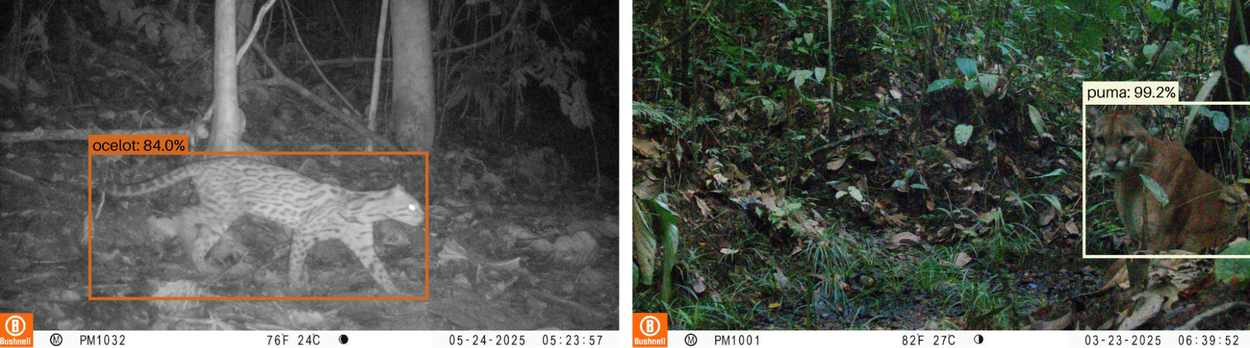
These images were captured in Colombia by Project Lucitania at the Universidad de los Andes, one of the participants in the national Red Otus project. Left: An ocelot, a small wild cat that’s endangered in the southern U.S. and Mexico, but is still common in South America. Right: A puma (also known as a cougar or mountain lion) that’s barely visible in the dim light. Credit: Project Lucitania/Universidad de los Andes/Red Otus
SpeciesNet has been operational within the Google Cloud-based Wildlife Insights platform since 2019. Wildlife Insights is a community platform that hosts approximately 200 million images with human-verified labels. SpeciesNet helps Wildlife Insights users label their images; any of those labeled images that are human-verified can in turn provide training data for SpeciesNet.
SpeciesNet was trained on a set of over 65 million images, including curated images from the Wildlife Insights user community, as well as labeled images from publicly available repositories. The model uses a convolutional neural network to identify animals down to the species level, if possible, in varying conditions of lighting, angle, and distance to the subject. This extensive training dataset has enabled the SpeciesNet model to find 99.4% of images containing animals as measured on a held-out test set of camera trap projects. 83% of the time, it categorizes the animal down to the species level, and 94.5% of those predictions are correct. Further details regarding the model's training data, performance, and evaluation can be found in our 2024 publication.

Images captured by the Idaho Department of Fish and Game (IDFG) show a family of black bears, a coyote, a mule deer and an elk. IDFG uses hundreds of camera traps to monitor species, especially in the more forested northern part of the state. Credit: Idaho Department of Fish and Game
SpeciesNet partner projects around the world
Over the past year, some standout projects include:
- Millions of wildlife images from the African savanna captured since 2010 through the Snapshot Serengeti camera trapping program can now be analyzed. While early images were analyzed by citizen scientists, over time the influx of images outpaced the volunteers’ capacity. With SpeciesNet, Todd Michael Anderson at Wake Forest University is now analyzing this trove of some 11 million images in just days. Having SpeciesNet installed on his laptop also means Anderson can process camera trap data in the field, then use the latest wildlife sightings to redeploy cameras in real time to collect targeted data.
- Several groups have adapted SpeciesNet to their local species. In Australia, the Wildlife Observatory of Australia (WildObs) has trained a version of SpeciesNet on animals not included in the existing 2,498 labels. WildObs trained SpeciesNet on images of species found only in Australia, such as the musky rat-kangaroo and the orange-footed scrubfowl, that can recognize key species in Australia, home to many unique and threatened species. WildObs is also feeding its new images and training data back into the larger community through the Wildlife Insights platform.
- Government wildlife and transportation agencies are using SpeciesNet to help process their camera trap data. For example, the Idaho Department of Fish and Game has added SpeciesNet to its existing workflow when analyzing images from the hundreds of cameras it uses to monitor deer, elk, black bears and other wildlife, including rare and endangered species. Camera traps are particularly useful in the more forested northern part of the state. SpeciesNet is used as a first pass in species identification that greatly speeds up the final step of human verification.
- Millions of new users now have access to SpeciesNet through public and private platforms. Web-based resources such as The Nature Conservancy’s camera trap data platform, Animl, have now added SpeciesNet to their model repertoires. AddaxAI, a desktop tool that allows ecologists to process images through AI models on their own computers, has also incorporated SpeciesNet. Private companies are also using SpeciesNet. For example, Okala uses SpeciesNet and a Google-developed AI audio tool, Perch, to monitor biodiversity across several countries in Africa.
- Wildlife Insights, the original home of SpeciesNet, has also grown over the past year. In Colombia, the Humboldt Institute has expanded its camera trapping efforts into a national-scale network, Red Otus, that captures camera trap images on public and private land. Since launching Red Otus in 2024 at COP16, the group has quadrupled the size of its network, to 446 cameras and more than 100,000 images captured in 2025. It is using these data to determine changes in the daily patterns of mammals and migratory birds. Analysis suggests that some mammals are becoming more nocturnal, perhaps to avoid threats, and birds appear later in the morning in developed areas, perhaps to avoid predators.

Images captured by the Wildlife Observatory of Australia (WildObs), one of the groups that has trained the open-source version of SpeciesNet to identify additional species of local importance. Left: A pair of red-legged pademelons, a type of wallaby, that appear to be wrestling. Middle: An orange-footed scrubfowl. Right: A single cassowary that’s looking straight into the camera. Credit: Wildlife Observatory of Australia
Looking ahead
In releasing SpeciesNet as an open-source resource we aimed to foster collaboration and accelerate advances in wildlife monitoring and conservation worldwide. The GitHub repository provides access to the code, documentation, and resources necessary for running and adapting the model. We encourage the community to continue to contribute to the project, refine the model, and expand its capabilities as early adopters of the open-source tool have done.
Research groups or individuals who prefer a platform that easily and quickly runs SpeciesNet and helps manage data and collaborate with other groups are encouraged to explore the Wildlife Insights platform — a global resource for biodiversity monitoring and management.
SpeciesNet represents a significant step forward in automating and accelerating the analysis of wildlife images, from baboons to wallabies. Our goal is to support development of AI models in an ongoing, collaborative effort to understand and protect biodiversity, worldwide.
Acknowledgments
Thank you to all of the scientists whose contributions to Wildlife Insights made SpeciesNet possible. Special thanks to Tomer Gadot and Ștefan Istrate, who led SpeciesNet’s training. Projects with questions about using SpeciesNet should contact cameratraps@google.com.
Other posts of interest
-

September 24, 2026
Automating coherent long-form video generation- Generative AI ·
- Machine Intelligence
-
September 17, 2026
The future of practice: Enabling teachers to create learning interactives with generative UI- Education Innovation ·
- Generative AI ·
- Machine Intelligence
-
September 15, 2026
Bypassing inference bottlenecks: Accelerating complex AI search with Retrieve-for-Train- Algorithms & Theory ·
- Data Mining & Modeling ·
- Generative AI


